Lebanon’s Cumulative Trade Deficit Up by 5.64% YoY to $12.96B by September 2026
According to the Lebanese Customs Administration, Lebanon’s cumulative trade deficit increased by 5.64% year-over-year (YoY), to reach $12.96B by September 2026. This change was driven by a cumulative 4.10% YoY ($15,600 million) surge in imports by September 2026 and a 2.84% YoY ($2,637 million) fall in exports during the same period.
The widening trade deficit reflects Lebanon’s continued reliance on imports alongside the lingering effects of the conflict on domestic production and export activity. In September 2026, improving domestic demand and business activity, reflected in the BLOM Lebanon PMI rising to 50.5, supported consumption and demand for imported goods. However, higher energy and transportation costs continued to inflate the import bill, while persistent regional instability, disrupted supply chains, and weak external demand constrained exports. Consequently, the recovery in domestic activity continued to benefit imports more than exports, contributing to the widening trade deficit despite signs of improving economic conditions
Lebanon’s Balance of Trade (USD Million)

YTD: Year to Date
Top Import Destinations for Lebanon (YTD up to September 2026)
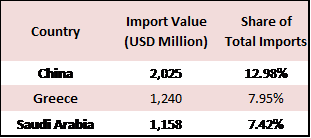
The top three import destinations by September 2026 were China, Greece, and Saudi Arabia accounting for 12.98%, 7.95%, and 7.42% of the total value of imports, respectively. The top imported products were Mineral products (28.12%) at $4,386 million, Pearls, precious stones and metals (10.06%) at $1,570 million, and Products of the chemical or allied industries (9.45%) at $1,474 million.
Top Export Destinations for Lebanon (YTD up to September 2026)
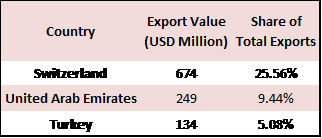
On the exports side, the top three destinations by September 2026 were Switzerland, United Arab Emirates, and Turkey capturing respective shares of 25.56%, 9.44% and 5.08% of the total value of exports. The top exported products were Pearls, precious stones and metals (34.36%) at $906 million, Base metals and articles of base metal (15.55%) at $410 million, and Prepared foodstuffs, beverages, tobacco (12.55%) at $331 million.